
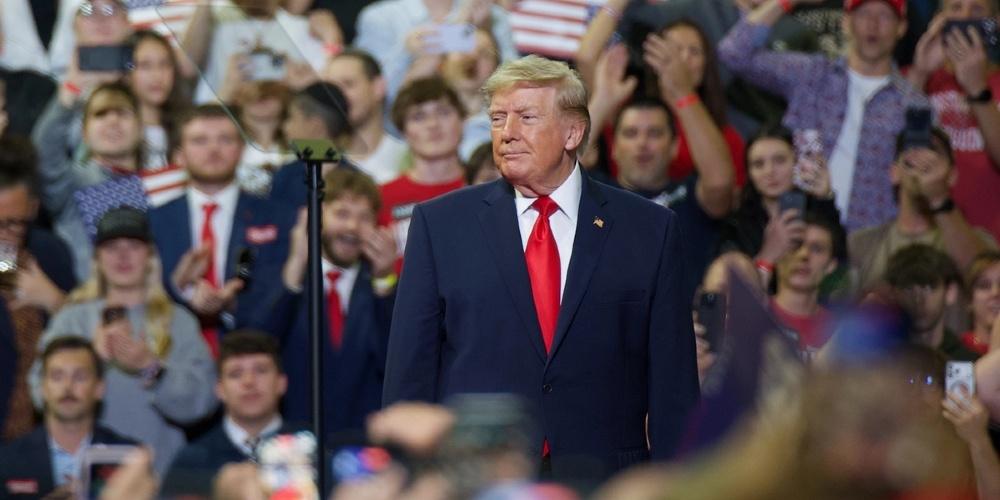
(The Epoch Times)—While past presidents have attempted to distance themselves from the midterm spotlight, President Donald Trump has urged voters to treat the Nov. 3 election with the weight of a presidential election.
“When I’m not on the ballot, we don’t do well,” Trump has said in multiple speeches over the past month as part of his nationwide campaign blitz for a GOP majority in both houses of Congress.
“In this election, I’m asking you to pretend I’m on the ballot just one more time. Because, essentially, I am.”
Historically, midterms have served as a referendum on the policies of the sitting president, giving voters an opportunity to approve and accelerate the presiding party’s agenda or put a check on the executive branch’s power.
If the polls are accurate this year, Democrats are poised to flip enough seats in the House of Representatives, with a closer contest in the Senate. Republicans currently hold slim majorities in both chambers—218 to 214 and 53 to 47, respectively. Democrats need net gains of four seats in each chamber to win control.
Market analysts at Action Network reported an 86 percent chance of a change in leadership in the House and a 66 percent chance that the Senate flips, based on their modeling of prediction markets.
The national mood in favor of Democrats has remained steady throughout the fall by roughly 8 to 9 percentage points, at about 51–52 percent versus 42–44 percent for Republicans.
“The model doesn’t look at Iran, the economy, or corruption directly, but they show up as points of national mood,” Tyler James Webber of the Action Network told The Epoch Times on Nov. 2. And that figure “outweighs every other input combined,” he said.
- Hand-curated links from conservative and Christian sites — NO legacy media garbage links. Patriots get their news every day at JDRucker.com
He noted that traditional polls underestimated Republican turnout in six of the past seven midterms, a factor that was considered in his team’s calculations.
Historical Precedent
Sitting presidents watched their parties lose ground in all but two of the 20 midterm elections held since World War II.
Presidents Bill Clinton and George W. Bush bucked the trend in 1998 and 2002 when their parties gained ground. At the time, both presidents’ approval ratings were north of 60 percent.
Bush later lost both chambers in 2006 when his approval plummeted to 37 percent.

Trump’s disapproval rating sits at about 60 percent as of Oct. 30, with his approval rating hovering around 37 percent, up one point from his all-time lows in early October, according to recent polls.
Democrats gained 40 House seats in the 2018 midterms during Trump’s first term, but Republicans gained two seats in the Senate.
Pre-election voting data compiled by the University of Florida’s Election Lab show fewer Republicans voting early than in past elections, with higher turnouts for Democrats and independents. Conservative voters historically turn out in higher numbers on Election Day.
Top Issues
Trump packed his schedule with near-daily rallies through October to boost his party’s chances, with his voice going noticeably hoarse toward the end of the month.
Across the country, voters told The Epoch Times that high fuel prices, inflation, and the Iran war were the most important issues for them heading into Election Day.
Supporters of all ages expressed their approval of his leadership.
“I’m here because I believe in what the president is doing for our country,” Bob Spears of northern Kentucky told The Epoch Times before a rally. “There’s a lot of bad information out there, and we need to stand up for our principles while we can.”
Others looking for change came to voice their opposition to the administration, with organized protests outside most rallies and disruptions occurring at many of Trump’s recent events.
Common themes of protests included the cost of living, Epstein file transparency, and anti-war messages.
“We’re out here to make a statement and make a difference,” one protester, Matt, who only gave his first name, told The Epoch Times while holding a sign outside a rally in Kalispell, Montana, calling for lower gas and food prices.
“If we could afford groceries to feed our family, we wouldn’t be out here in the cold complaining.”
Both parties flooded the airwaves with pundits urging their bases to turn out with a slew of messages to challenge their opponents.
Democrats embraced Trump’s framing of the election as a referendum, running ads in battleground states tying Republican candidates to his policies, which they blame for the continued high cost of living.
Evolving Battleground Map
Rhetoric about the economy created electoral opportunities for Democrats in states that traditionally vote red.
Kansas hasn’t elected a Democrat senator since George McGill was reelected in 1932, but the party’s Adam Hamilton is leading in some polls over Republican Sen. Roger Marshall.
In Texas, Republican Ken Paxton is trailing Democrat James Talarico, according to recent polling data. The pair are running for outgoing Republican Sen. John Cornyn’s seat after the sitting senator was ousted in a primary following disagreements with Trump over spending and other legislative details.
Cornyn subsequently refused to campaign for Paxton, describing him as an “albatross around the neck” of GOP candidates during a May press conference.
Trump chastised Cornyn for not supporting the party down the stretch, blaming him and political strategist Karl Rove for a potential defeat in the Lone Star State.
“They are hurting Texas and, more importantly, hurting the United States of America!” Trump wrote Oct. 15 on Truth Social, saying that both had opposed him for his entire political career.
The president held rallies in San Antonio, Corpus Christi, and Lubbock in October to stump for Paxton, Texas Gov. Greg Abbott, and other GOP candidates.
In Alaska, Democrat Mary Peltola is running to unseat Republican Sen. Dan Sullivan. The race includes another Dan Sullivan, which Republicans say risks confusing voters.
The Department of Justice challenged the second Sullivan’s inclusion on the ballot, but U.S. District Court Judge Sharon Gleason dismissed the case on Nov. 1. The government is appealing the ruling.
In Maine, longtime Republican Sen. Susan Collins is facing a tough race against Democrat Troy Jackson in her bid for a sixth straight term. Polls show Jackson with a slight edge hours before Election Day.
North Carolina Republican Sen. Thom Tillis’s decision to retire after clashing with Trump resulted in a race between former Republican National Committee Chair Michael Whatley and former Democrat Gov. Roy Cooper. Cooper holds a comfortable lead in all major polling results.
Democrats are hoping to flip Ohio in a race pitting their former Sen. Sherrod Brown against incumbent Republican Sen. John Husted, who filled Vice President JD Vance’s seat. The race leans Democrat, with longtime politician Brown’s name recognition boosting his chances, according to recent surveys.
Trump made three visits to the Buckeye State in October and another to the Cincinnati media market in Highland Heights, Kentucky.
Other close contests include Iowa, where Republican Ashley Hinson is running against Democrat Josh Turek to replace retiring Republican Sen. Joni Ernst. Ernst told reporters in September 2025 that she received “a lot of pressure from the White House” to seek reelection but chose to return to private life.
The president has also campaigned aggressively for Republican Mike Rogers in his race against Democrat Abdul El-Sayed in Michigan.
Trump drew contrasts between his administration’s domestic manufacturing and national security agendas and those of El-Sayed and other far-left Democrat candidates, whom he labeled as “socialists and communists.”
The president on Nov. 2 made a final push with his address in front of the Lincoln Memorial Reflecting Pool, thanking supporters who attended the GOP events while urging them to vote on Tuesday.
“Nobody’s ever seen anything like it, and that means there’s love,” Trump said. “Those rallies were love.”
What’s at Stake
If Democrats emerge victorious in both chambers, the party would hold subpoena power and control of congressional committees for Trump’s remaining two years. Members could review the administration’s economic and foreign policy decisions, in addition to the president’s family’s activities.
When Democrats controlled the House of Representatives in the last half of Trump’s first term, members of Congress persistently pursued investigations and impeachment hearings.
A Republican loss this year would threaten the progress made in Trump’s second term and force a reliance on executive orders, according to the president, as the opposition party would be able to constrain the executive branch through legislative efforts and send bills to the White House that don’t align with the administration’s agenda.
“I have a strong veto,” Trump told reporters when asked how he would handle a Democratic-majority Congress.
Some former supporters are critical of the steps taken by the president since he was returned to the White House by voters in 2024.
Conflicts with former Rep. Thomas Massie (R-Ky.), who describes himself as a libertarian Republican, and Christian nationalist former Rep. Marjorie Taylor Greene (R-Ga.), among others, led to a splintering of support among the right wing.
Trump said in November 2025 that Greene had “gone Far Left.”
Americans casting their ballots Tuesday will decide whether the president has succeeded in mobilizing his base to defend his administration’s policies or Democrats have gained enough momentum to change the balance of power.
Two Storms, One Harvest

Every food crisis in living memory has been a one-shock event. The 2008 price spike was a commodity bubble. The 2020 shortages were a logistics failure. The 2022 grain scare was a war on one exporter’s ports. Each time, the system bent, adjusted, and recovered, and each time the experts assured us afterward that global markets are simply too big and too diversified to fail.
What nobody in Washington seems eager to discuss is that 2026 is shaping up to be something the modern food system has never actually faced. Two independent shocks, one climatic and one geopolitical, are converging on the same harvest cycle at the same time. Not sequentially. Simultaneously.
Start with the weather. The Pacific Ocean is currently building toward what forecasters now openly call a record event. NOAA’s Climate Prediction Center puts the odds of at least a strong El Niño near 88 percent, with roughly two in three odds it reaches “very strong” status, the tier reserved for perhaps three or four events in the entire satellite era. Every major global model now projects a median peak in Super El Niño territory, and most of them project it exceeding the 2015-16 event, which until now held the modern record. Sea surface anomalies were already brushing the super threshold in mid-July, months before these events normally peak. The atmosphere has already shifted into El Niño mode, and the event is forecast to crest in late fall and early winter.
This is not about “climate change.” It’s about the standard cycles of weather, and the cycle we’re currently in is one that has likely devastated societies in the past. We’re better prepared as a society today, but not all Americans are equally prepared.
Serious households have started doing the quiet math on their own. Grocery bills tell part of the story, and the forecast maps tell the rest, which is why long-term food storage has moved from fringe hobby to mainstream line item in the family budget, with established suppliers like Heaven’s Harvest seeing demand from people who five years ago would have rolled their eyes at the idea. That instinct is not paranoia. It is pattern recognition, and the pattern is worth walking through carefully.
Editor’s Note: Heaven’s Harvest IS a sponsor, but the warnings of this article are real and would be written even if we didn’t have a survival food sponsor. With that said, those who take advantage of what they offer can use promo code “Patriot” for 15% off.
The Fertilizer Clock Is Already Running
While the Pacific warms, the second shock has been unfolding in the Strait of Hormuz. The conflict with Iran turned the world’s most important energy chokepoint into a contested waterway, and the consequences reach far beyond the gas pump. Roughly a third of global fertilizer trade moves through Hormuz, and the disruption sent urea prices up 86 percent year over year by March, with a 53 percent jump in a single month.
The World Bank projects energy prices rising about 24 percent in 2026 and fertilizer about 31 percent. By its own accounting, fertilizer prices ran 35 percent higher in the first five months of this year than the same period last year.
Here is the mechanism the nightly news will not explain. Fertilizer is not a grocery item. It is a time-delayed input. The nitrogen a farmer in Iowa or Punjab could not afford to apply this spring does not show up as a problem this spring. It shows up as a thinner harvest six to twelve months later.
The World Bank’s own food security brief concedes that the effects of reduced applications earlier this season “are likely to become visible only later in harvest outcomes.” Translate that from institutional language into plain English and it means this. The damage is already done, it is already in the ground, and we are simply waiting for it to arrive on the shelf.
Now check the calendar. Six to twelve months from the spring planting season lands us squarely in late 2026 and early 2027. Which is precisely when the strongest El Niño in the instrumental record is forecast to peak, bringing its signature droughts to Southeast Asia, Australia, southern Africa, northern Brazil, and South Asia, the very regions that grow the world’s rice, sugar, and oilseeds.
The World Bank warns openly that a strong El Niño “could disrupt multiple crop belts simultaneously” on top of the conflict-driven input costs. Their baseline projection assumes the Middle East disruptions ease by autumn. What in the last two years of Middle East history suggests that assumption is safe?
The System Has No Slack Left
The comfortable answer is that global markets always adjust. But adjustment requires slack, and the slack is gone. Global cereal production is expected to decline from last year’s records even before El Niño does its work. The UN World Food Programme, hardly a den of right-wing preppers, is calling this the most significant disruption to its supply chains since Covid and the invasion of Ukraine, and its supply chain director put the stakes bluntly.
Today’s supply chain challenges are tomorrow’s hunger crisis.
There is also a political dimension that markets cannot price. When food gets scarce, governments do not behave like economists. They behave like politicians. Export bans, hoarding mandates, and panic buying at the national level turned the modest rice shortfall of 2008 into a global crisis, and analysts are already warning that import-dependent nations are the first dominoes.
The 2015-16 Super El Niño, a far weaker event than what is now forecast, threw tens of millions into food stress across Africa and Asia. This one is projected to be stronger, and it arrives with fertilizer already rationed by price and shipping lanes already contested by missiles.
What Joseph Knew
Scripture does not treat preparation for lean years as faithlessness. It treats it as wisdom delivered in advance to those willing to act on it.
Behold, there come seven years of great plenty throughout all the land of Egypt: And there shall arise after them seven years of famine; and all the plenty shall be forgotten in the land of Egypt.
Joseph did not respond to that warning with a hashtag or a committee. He stored grain during the years of abundance, and when the famine came, Egypt stood while its neighbors begged. The lesson is not that famine is certain. It is that the time to prepare is precisely when preparation still looks optional.
Nobody who filled a pantry in a year of plenty has ever regretted it, and nobody standing in an empty aisle has ever been glad he waited for certainty.
None of this calls for panic, and panic is the enemy of sound judgment anyway. It calls for the same unglamorous prudence our grandparents considered ordinary. Keep some cash margin, know your local growers, and put real food in deep storage while it is cheap and available, because the entire arc of this story is that cheap and available is a closing window.
Families looking for a straightforward place to start can visit Heaven’s Harvest and use promo code Patriot for 15 percent off long-term storable food. The forecasts may yet soften, the strait may yet reopen, and we should pray they do. But hope is a fine thing to hold and a foolish thing to eat.