
(The Economic Collapse Blog)—Can you feel it? There is a tremendous amount of uncertainty in the air, and it appears that things could be about to break loose all around us. On Friday, chaos erupted on Wall Street as tech stocks crashed really hard. Most people don’t realize this, but nearly five trillion dollars in tech stock wealth has already been wiped out on the Nasdaq 100 since October 6th.
Meanwhile, there was more violent rioting in Europe this weekend, the upcoming midterm elections could spark similar rioting here in the United States, and on top of everything else the Middle East is bracing for renewed fighting with Iran. This could potentially be a week that we will remember for a long time to come.
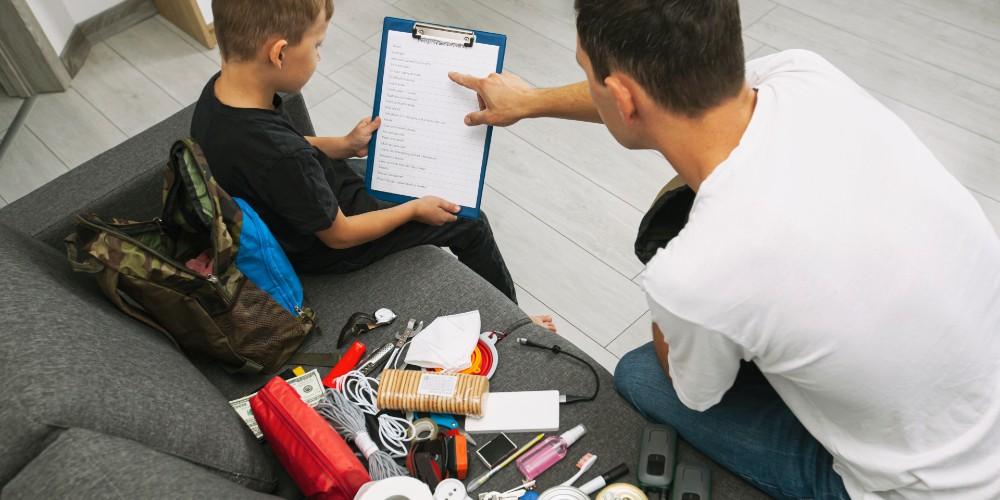
Last week, social media was absolutely buzzing with speculation about why governments all over the world are suddenly urging their citizens to stockpile food, water and emergency supplies…
Governments across Europe and Asia are increasingly asking households to prepare for emergencies by keeping essential supplies at home, from drinking water and non-perishable food to medicines, batteries and cash. The guidance is drawing attention as officials warn that natural disasters, cyberattacks and hostile-state activity could disrupt everyday services sooner than expected. Times Now reported earlier that Japan is preparing a nationwide disaster-readiness appeal, while Britain launched its ‘Be Ready’ public campaign urging households to remain self-sufficient for at least 72 hours.
Now France has released official guidance for assembling a three-day emergency kit. The announcements have emerged amid heightened geopolitical tensions, leading to concerns worldwide. According to Daniel Aldrich, Dean’s Professor of Resilience at Northeastern University, “We are living through a polycrisis. Shocks no longer arrive one at a time. A storm knocks out power, the outage freezes payment systems, and a cyber intrusion lands on top of both.”
In most cases, people are being encouraged to have enough to survive for 72 hours.
But in Germany, officials are instructing citizens to have at least a 10 day supply…
Germany recommends that residents maintain enough food, water, and other necessities to sustain themselves for up to 10 days.
Its Federal Office of Civil Protection and Disaster Assistance (BBK) acknowledges that not every household can immediately build a 10-day supply, making three days of preparedness a practical starting point.
The agency’s updated guidance addresses prolonged power outages, extreme weather, misinformation, and security emergencies, including situations involving armed conflict.
What do they think is going to happen?
Even as governments issue these ominous instructions, they are assuring us that everything is fine, but meanwhile the U.S. Army is preparing for a scenario in which the digging of “mass battlefield graves” will be necessary…
The U.S. Army has conducted military exercises involving the excavation of mass battlefield graves, preparing for a potential future war in which casualties could become so overwhelming that bringing fallen soldiers home promptly would no longer be possible.
The drills, dubbed Operation Dragon Covenant, were held in North Carolina earlier this month and brought together military engineers, chaplains, medical personnel, and fatality management specialists to practice burying large numbers of bodies in temporary battlefield trenches, Army Times reports.
Engineers reportedly used D6 bulldozers to excavate trenches capable of holding 20 bodies in roughly 75 minutes. Commanders calculated that a properly equipped engineering company could dig and cover trenches for 2,400 bodies in 24 hours of nonstop operations.
Without a doubt, I do believe that global events are reaching a critical turning point.
On Monday, we will want to watch the financial markets very closely, because last week ended very badly.
Stocks tend to fall a lot faster than they rise, and what we just witnessed was absolutely stunning.
On Friday, approximately 2 trillion dollars in stock market wealth was suddenly wiped out…
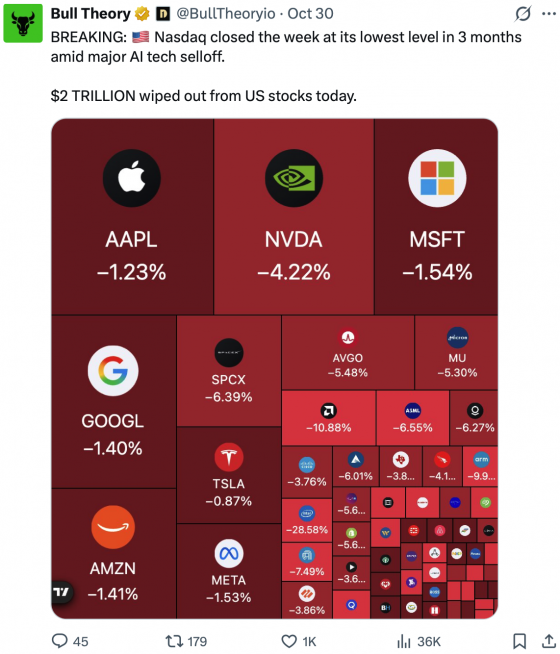
Some were calling it “Bloody Friday”, and Intel got hit particularly hard…

Intel, meanwhile, tanked almost 29% after issuing a weak outlook for the current quarter, pointing to a slowdown in PCs. Revenue in the company’s client computing and physical artificial intelligence group declined 5% from the year-ago quarter to $8.1 billion.
Sandisk was also down 13%, even as its fiscal first quarter results beat estimates. The data storage company announced an eight-for-one forward stock split.
Chipmakers more broadly were under pressure as well. Advanced Micro Devices dropped close to 11%, while others such as Nvidia and Broadcom fell 4% and 5%, respectively.
What goes up must eventually come down.
Over the past year, investors have engaged in an epic borrowing binge, and when margin debt increases so rapidly it almost always has a bad ending…
Investors are borrowing heavily against their portfolios to boost their returns. Over the past year, margin debt has increased by 49%. That’s a bad omen. According to Fundstrat Global Advisors, whenever margin debt has grown more than 45% year-over-year since 1960, the market has declined five out of six times (83%). That’s a signal worth watching.
Of course it isn’t just U.S. stocks that have been falling.
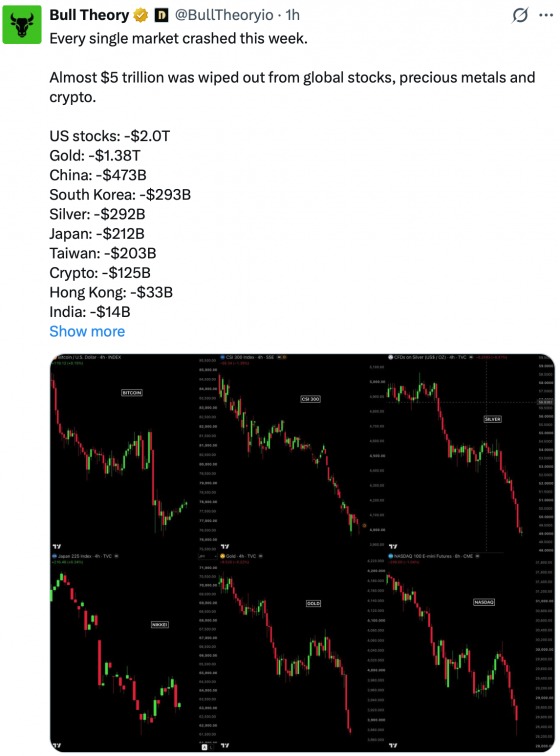
Last week, global investors lost a grand total of nearly 5 trillion dollars…
Now we will wait to see what happens on Monday.
If global markets bounce back, that will be a very good sign.
If they do not, that could be a harbinger of bad things to come.
On Tuesday, the focus will be on the midterm elections in the United States.
Historically, the party that is holding the White House does not do well…
Pain is the norm for White House incumbents when the midterms roll around. In 1994, Bill Clinton suffered a 54-seat setback in the House of Representatives; in 2010, Barack Obama lost 63; in 2018, Trump himself lost 40.
Democrats are expecting to do extremely well on Tuesday, and the polls are reinforcing those expectations…
With Republicans clinging to a paper-thin 218–214 margin in the House and 53–47 lead in the Senate, opinion polls indicate a rising “blue wave”. A recent Reuters/Ipsos survey gave Democrats an 11-point lead, 47% to 36%, on the generic congressional ballot, while Trump’s approval rating stood at 32%. Voters will also choose governors in 36 states and three US territories, and decide thousands of state legislative contests.
At this stage, the left believes that winning the House is absolutely certain and they are being told that there is about a 70 percent chance that they will win the Senate too.
If the Democrats do not win the Senate, the left will be extremely angry.
The most important Senate races to watch are Texas, Alaska and Michigan.
And if the Democrats do not win the House, the left will go absolutely ballistic.
Let’s watch and see what happens.
A lot of political anger has been building up for months, and it won’t take much to cause a major explosion.
In the aftermath of the midterms, just about everyone is expecting the U.S. and Israel to bomb Iran.
In anticipation of that operation, cargo aircraft have been transporting air defense batteries to Israel…
The US has transferred 10 military cargo aircraft to Israeli air bases in the southern Negev region amid preparations for a possible military strike against Iran, the Israeli public broadcaster KAN reported Thursday.
The broadcaster said the aircraft landed at Ovda and Nevatim air bases, while additional US military planes were reportedly dispatched to bases in Jordan, Saudi Arabia and Qatar.
According to KAN, the planes departed from Fort Bliss in the US state of Texas, which houses one of the US military’s largest air defense centers, including facilities associated with interceptor missiles and air defense batteries.
It has also been pointed out that at least 13 KC-135 Stratotanker refueling aircraft are currently parked at Israel’s Ramon International Airport…

All of the military assets needed for the coming operation are either in place or will be in place shortly.
The Iranians know this, and they are threatening to respond with an “earth-shattering blow”…
Iran threatened an “earth-shattering blow” against the United States and Israel on Saturday, warning that “red lines are a thing of the past” if either resumes military strikes against the Islamic Republic, as President Donald Trump weighs renewed action amid escalating threats from Tehran.
If there are no more red lines, what sort of weapons might they use?
We are also being warned that Iran will no longer limit themselves to attacks in the Middle East…
Iran’s rapidly evolving defense doctrine allows military retaliation beyond the geographical area from which an attack originates, Mohammad Mokhber, an adviser to Supreme Leader Mojtaba Khamenei, said Sunday.
“The geography of a threat no longer determines the geography of the response,” Mokhber wrote on X, describing what he called a “rapid shift” in Tehran’s military strategy.
Most people assume that Iran could never threaten those of us living in the United States and Europe.
That is not a safe assumption at all.
The Iranians have far more cards up their sleeves than most people realize.
And if they push things too far, that could spark an all-out apocalyptic showdown in the Middle East.
Decisions that are made this week could radically alter the course of human history.
So buckle up and hold on tight, because I have a feeling that things are about to get really wild.
Michael’s new book entitled “10 Prophetic Events That Are Coming Next” is available in paperback and for the Kindle on Amazon.com, and you can subscribe to his Substack newsletter at michaeltsnyder.substack.com.
Two Storms, One Harvest

Every food crisis in living memory has been a one-shock event. The 2008 price spike was a commodity bubble. The 2020 shortages were a logistics failure. The 2022 grain scare was a war on one exporter’s ports. Each time, the system bent, adjusted, and recovered, and each time the experts assured us afterward that global markets are simply too big and too diversified to fail.
What nobody in Washington seems eager to discuss is that 2026 is shaping up to be something the modern food system has never actually faced. Two independent shocks, one climatic and one geopolitical, are converging on the same harvest cycle at the same time. Not sequentially. Simultaneously.
Start with the weather. The Pacific Ocean is currently building toward what forecasters now openly call a record event. NOAA’s Climate Prediction Center puts the odds of at least a strong El Niño near 88 percent, with roughly two in three odds it reaches “very strong” status, the tier reserved for perhaps three or four events in the entire satellite era. Every major global model now projects a median peak in Super El Niño territory, and most of them project it exceeding the 2015-16 event, which until now held the modern record. Sea surface anomalies were already brushing the super threshold in mid-July, months before these events normally peak. The atmosphere has already shifted into El Niño mode, and the event is forecast to crest in late fall and early winter.
This is not about “climate change.” It’s about the standard cycles of weather, and the cycle we’re currently in is one that has likely devastated societies in the past. We’re better prepared as a society today, but not all Americans are equally prepared.
Serious households have started doing the quiet math on their own. Grocery bills tell part of the story, and the forecast maps tell the rest, which is why long-term food storage has moved from fringe hobby to mainstream line item in the family budget, with established suppliers like Heaven’s Harvest seeing demand from people who five years ago would have rolled their eyes at the idea. That instinct is not paranoia. It is pattern recognition, and the pattern is worth walking through carefully.
Editor’s Note: Heaven’s Harvest IS a sponsor, but the warnings of this article are real and would be written even if we didn’t have a survival food sponsor. With that said, those who take advantage of what they offer can use promo code “Patriot” for 15% off.
The Fertilizer Clock Is Already Running
While the Pacific warms, the second shock has been unfolding in the Strait of Hormuz. The conflict with Iran turned the world’s most important energy chokepoint into a contested waterway, and the consequences reach far beyond the gas pump. Roughly a third of global fertilizer trade moves through Hormuz, and the disruption sent urea prices up 86 percent year over year by March, with a 53 percent jump in a single month.
The World Bank projects energy prices rising about 24 percent in 2026 and fertilizer about 31 percent. By its own accounting, fertilizer prices ran 35 percent higher in the first five months of this year than the same period last year.
Here is the mechanism the nightly news will not explain. Fertilizer is not a grocery item. It is a time-delayed input. The nitrogen a farmer in Iowa or Punjab could not afford to apply this spring does not show up as a problem this spring. It shows up as a thinner harvest six to twelve months later.
The World Bank’s own food security brief concedes that the effects of reduced applications earlier this season “are likely to become visible only later in harvest outcomes.” Translate that from institutional language into plain English and it means this. The damage is already done, it is already in the ground, and we are simply waiting for it to arrive on the shelf.
Now check the calendar. Six to twelve months from the spring planting season lands us squarely in late 2026 and early 2027. Which is precisely when the strongest El Niño in the instrumental record is forecast to peak, bringing its signature droughts to Southeast Asia, Australia, southern Africa, northern Brazil, and South Asia, the very regions that grow the world’s rice, sugar, and oilseeds.
The World Bank warns openly that a strong El Niño “could disrupt multiple crop belts simultaneously” on top of the conflict-driven input costs. Their baseline projection assumes the Middle East disruptions ease by autumn. What in the last two years of Middle East history suggests that assumption is safe?
The System Has No Slack Left
The comfortable answer is that global markets always adjust. But adjustment requires slack, and the slack is gone. Global cereal production is expected to decline from last year’s records even before El Niño does its work. The UN World Food Programme, hardly a den of right-wing preppers, is calling this the most significant disruption to its supply chains since Covid and the invasion of Ukraine, and its supply chain director put the stakes bluntly.
Today’s supply chain challenges are tomorrow’s hunger crisis.
There is also a political dimension that markets cannot price. When food gets scarce, governments do not behave like economists. They behave like politicians. Export bans, hoarding mandates, and panic buying at the national level turned the modest rice shortfall of 2008 into a global crisis, and analysts are already warning that import-dependent nations are the first dominoes.
The 2015-16 Super El Niño, a far weaker event than what is now forecast, threw tens of millions into food stress across Africa and Asia. This one is projected to be stronger, and it arrives with fertilizer already rationed by price and shipping lanes already contested by missiles.
What Joseph Knew
Scripture does not treat preparation for lean years as faithlessness. It treats it as wisdom delivered in advance to those willing to act on it.
Behold, there come seven years of great plenty throughout all the land of Egypt: And there shall arise after them seven years of famine; and all the plenty shall be forgotten in the land of Egypt.
Joseph did not respond to that warning with a hashtag or a committee. He stored grain during the years of abundance, and when the famine came, Egypt stood while its neighbors begged. The lesson is not that famine is certain. It is that the time to prepare is precisely when preparation still looks optional.
Nobody who filled a pantry in a year of plenty has ever regretted it, and nobody standing in an empty aisle has ever been glad he waited for certainty.
None of this calls for panic, and panic is the enemy of sound judgment anyway. It calls for the same unglamorous prudence our grandparents considered ordinary. Keep some cash margin, know your local growers, and put real food in deep storage while it is cheap and available, because the entire arc of this story is that cheap and available is a closing window.
Families looking for a straightforward place to start can visit Heaven’s Harvest and use promo code Patriot for 15 percent off long-term storable food. The forecasts may yet soften, the strait may yet reopen, and we should pray they do. But hope is a fine thing to hold and a foolish thing to eat.