

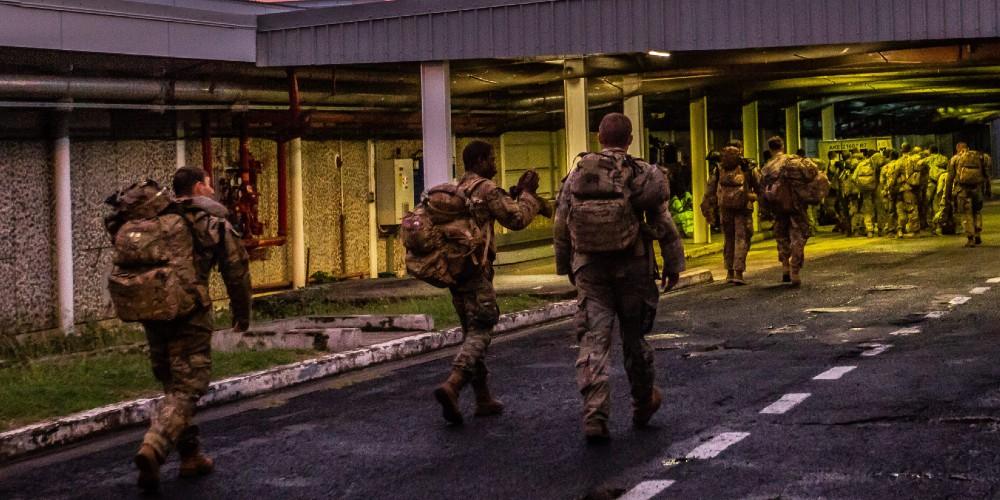
 (DCNF)—The Department of War (DOW) is equipping snipers with a rifle using a technology it discarded for front-line troops over 85 years ago.
The Barrett MRAD rifle was selected by DOW to serve as the Mk 22 Precision Sniper Rifle. The Army is paying the Tennessee gun manufacturer $49.9 million for 2,800 rifles, while the Marine Corps is acquiring another 250, according to Soldier of Fortune. The Mk 22 comes in three calibers: 7.62x51mm NATO, .300 Norma Magnum and .338 Norma Magnum. It has a ten-round detachable magazine and uses a bolt-action system, which at first glance seems obsolete, but one former sniper told the Daily Caller News Foundation that the older system was still useful.
“Bolt action rifles are more consistent, more reliable, more durable, easier to maintain in the field,” attorney Ryan Cleckner, a former sniper with the United States Army’s 75th Ranger Regiment, told the DCNF. “Secondary, kind of like, I’m not a NASCAR fan, I don’t know if you are, but NASCAR, they still use manual transmissions, they still shift with the clutch when we have great automatic transmissions in cars now. Why? Well, because an automatic transmission is too complicated, too finicky, and doesn’t allow the amount of control and robustness that the manual transmission needs. That’s a fair analogy to bolt action rifles.”
“When it comes to a rifle extracting a spent case, especially when it gets dirty or it is not perfect lubrication around in battlefield conditions, I, as a sniper grabbing the bolt handle, can easily rip the cartridge case out with my arm and push the next one in” Cleckner continued. “But if you’re relying on gas systems and things like that to work, they don’t always work. And then now you have a malfunction and your gun’s not even working, which is much, much slower than a bolt.”
The United States ditched bolt-action rifles for regular infantrymen in the months prior to World War II, replacing the M1903 Springfield with the M1 Garand to give troops additional firepower. Since then, regular infantrymen have used the M14, M16, and M7 rifles alongside the M4 and M8 carbines.
“The Army has fielded both gas and bolt operated sniper systems in multiple calibers. Each system meets distinct Warfighter requirements across a range of operational environments,” a U.S. Army spokesperson told the Daily Caller News Foundation. “The Mk 22 Precision Sniper Rifle (PSR) reflects a balanced, capability-based requirement that prioritizes deliberate precision, first-round hit probability, modularity, and mission adaptability.”
Snipers, though, mostly have used bolt-action rifles, like the M40 and M24/M2010 systems, but semiautomatic sniper rifles have been used by the United States military in the past. The M110 Semi-Automatic Sniper System, based on the Knight Armament Company’s SR-25, was introduced in 2008, according to GlobalMilitary.com and can fire either 7.62x51mm NATO or 6.5mm Creedmoor rounds, with a 20-shot magazine.
The M21 rifle was adopted by the United States Army during the Vietnam War, and was the weapon used by the top American sniper of the war, Army Staff Sgt. Adelbert Waldron, who had 109 confirmed kills.
The .338 Lapua has been used for some of the longest sniper engagements in history, including a shot of just over 2,700 yards by Corporal of Horse Craig Harrison of the British Army’s Household Cavalry. It was primarily used with the Accuracy International Arctic Warfare Magnum bolt-action rifle during the Global War on Terror.
Two companies, Rock River Arms and Noreen, have offered AR-15 platform rifles chambered for the .338 Lapua Magnum for sale on their websites. Both rifles are semi-automatic and have ten-round detachable magazines, but Cleckner said that the companies may not have been able to meet the DOW’s production standards, even though Rock River has secured contracts to produce firearms for the FBI and Drug Enforcement Agency (DEA).
“Those rifles are neat, but even some of these other contracts that come up by these smaller companies that will build field two to five really nice working samples for the military to decide that they like,” Cleckner told the DCNF. “In my experience with government contracting, I’ve had experience as the sniper in the military and I’m an attorney for gun companies for government contracting. So I help them help companies field these and get them through the selection process. The military invariably finds out that rifle number 1000 not only is that the same as rifle number one in standards, they often have different parts. They’ll just start using different springs at rifle number 400 because they ran out of the first springs or because their supply system isn’t robust enough.”
Barrett also made a popular sniper rifle used for some of the world’s longest shots, the M82/M107 rifle, a semi-automatic system which fires the .50 BMG round and has a ten-round magazine. Barrett, Noreen and Rock River Arms did not respond to requests for comment from the DCNF.

All content created by the Daily Caller News Foundation, an independent and nonpartisan newswire service, is available without charge to any legitimate news publisher that can provide a large audience. All republished articles must include our logo, our reporter’s byline and their DCNF affiliation. For any questions about our guidelines or partnering with us, please contact [email protected].
Starting the Day With a Scripture-Inspired Roast Helps Center Your Thoughts on Eternal Truths Amid Temporal Pressures
The world can seem chaotic, especially right after we wake up. Many believers start their mornings reaching for something familiar — a hot cup of coffee — yet end up settling for mediocre brews that do little more than deliver a caffeine jolt. The daily grind of life, with its endless distractions, news cycles, and responsibilities, can leave even the most faithful feeling spiritually parched alongside their physical fatigue. What if your morning ritual could do more than wake you up? What if it could ground you in truth, nourish your body with exceptional quality, and quietly advance a kingdom purpose at the same time?
That’s the promise — and the reality — behind Promised Grounds Coffee. This Christian-founded company doesn’t just roast beans; it approaches every step as an act of worship and discipleship. By selecting only the top 10% of specialty-grade beans, ethically sourced from dedicated farmers in Central and South America, and small-batch roasting them with reverence in Austin, Texas, Promised Grounds delivers what many describe as the best coffee available — never burnt, never bland, but rich with origin stories and layered flavors that honor God’s creation.
From the vibrant Psalm 27 Roast (a light, bright medium option) to the bold yet peaceful 2 Timothy 1:7 Decaf, each bag carries a Scripture verse that turns your daily pour into a gentle reminder of faith. And through their Ounce Per Ounce Promise, every ounce of coffee you enjoy provides an equal ounce of clean water to families in need via partnership with Filter of Hope — literally brewing hope for body and soul, one cup at a time.
The challenge for today’s Christians runs deeper than finding a decent cup. In an age of convenience-driven consumerism, it’s easy to support companies that dilute values or remain silent on matters of faith. Many believers want their everyday choices — from what they drink to how they spend — to reflect discipleship rather than just convenience. Promised Grounds solves this by weaving Christian excellence into the entire process: beans nurtured with prayerful stewardship by farming families, roasted as an offering rather than a commodity, and packaged with Bible verses to encourage a mindset of gratitude and purpose from the first sip. Reviewers consistently praise the smooth, rich profiles — whether enjoyed black in a drip maker, iced on a warm day, or shared in fellowship — noting how the quality stands toe-to-toe with premium secular brands while delivering something far more meaningful.
This integration of faith and flavor addresses a real need in Christian households and ministries. Busy parents, church leaders, and remote workers alike report that starting the day with a Scripture-inspired roast helps center their thoughts on eternal truths amid temporal pressures. The coffee’s exceptional character — bright citrus notes in lighter roasts or deep chocolate undertones in bolder ones — comes from meticulous selection and careful roasting that respects the bean’s natural gifts rather than masking them. It’s the kind of coffee that elevates a simple quiet time, fuels productive workdays, or sparks meaningful conversations when shared at Bible studies or outreach events. And because it’s ethically sourced with integrity, every purchase supports sustainable livelihoods for farmers who treat their crops like family harvests.
For those leading churches or small groups, the impact multiplies. Promised Grounds offers bundles and options perfect for hospitality ministries, turning ordinary coffee service into an opportunity to point people toward the living water of Christ. Imagine greeting visitors with a warm cup whose very bag carries God’s Word — a subtle yet powerful witness that aligns with the Great Commission. The company’s Texas roots and commitment to “brewing hope” resonate especially with believers who value American enterprise paired with global compassion.
Of course, quality alone isn’t enough if the experience feels out of reach. Promised Grounds keeps it accessible with practical perks like free shipping on orders over $40, sample sets for discovering favorites, and thoughtful add-ons such as faith-themed mugs. Whether you prefer whole beans for fresh grinding, grounds for convenience, or even bulk options for larger households and ministries, the result is consistently superior coffee that makes discipleship feel integrated rather than added on.
As you consider how to align even the smallest habits with your walk with God, Promised Grounds Coffee stands out as a refreshing solution. It tackles the dual problems of subpar daily sustenance and disconnected consumption by offering a product that genuinely excels in taste while advancing a mission of clean water, farmer dignity, and scriptural encouragement. Believers who make the switch often describe it as more than a beverage upgrade — it becomes part of their rhythm of gratitude, a daily invitation to remember that every good gift comes from above.
If you’re ready to transform your mornings (and perhaps your church gatherings) with coffee that honors both exceptional craftsmanship and Christian values, I encourage you to explore what Promised Grounds has to offer. One sip at a time, you’ll be nourishing your body, refreshing your spirit, and participating in something far greater — all while enjoying what truly is among the best coffee available.