
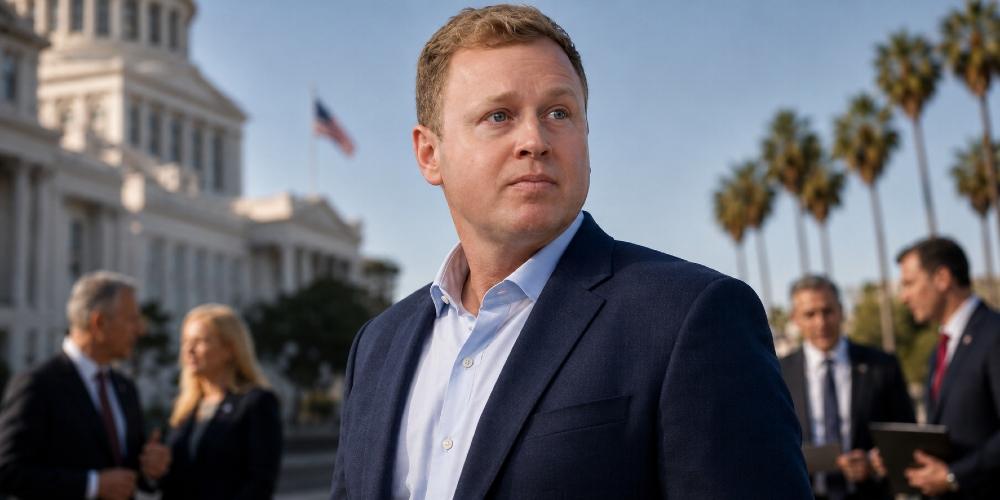
Spencer Pratt finished his primary night in second place, well ahead of a sitting city councilwoman, an heir to a half-century of progressive machine politics, and a dozen other candidates with résumés he does not have. In a city where registered Democrats outnumber Republicans by roughly four to one, a reality television personality who has been labeled as a Republican cracked the top two.
The Associated Press has already projected Karen Bass into the November runoff. As of Wednesday morning, with over half the ballots counted, Bass sat near 34 percent and Pratt over 30, with Councilwoman Nithya Raman trailing in the low twenties. The most remarkable political story in the country right now is happening in one of the bluest big city in America, and the candidate driving it is a man best known for “The Hills.”
Here is the thing Pratt’s team needs to understand before the confetti is swept up. The greatest threat to his candidacy between now and November is not Karen Bass. It is the Republican Party deciding that he belongs to them.
That sounds counterintuitive, but LA is different from pretty much everywhere else. Pratt did not reach second place by running as a Republican. He reached it by running as the man whose house burned to the ground while the mayor was in Ghana, the man who promised to walk into every dark corner of Los Angeles politics and turn on the lights.
His brand is grievance converted into competence, accountability stripped of party label. The moment that brand gets stamped with an official party logo, the entire architecture of his appeal begins to crack.
The Math That Explains Everything
Los Angeles is not a swing city. Its mayoral elections are technically nonpartisan, but everyone knows the underlying registration, and the underlying registration is brutal for any Republican. Democrats hold a commanding edge, and the city has not elected a Republican mayor since Richard Riordan left office in 2001. His election was predicated on the Rodney King riots.
A candidate who runs explicitly as the standard-bearer of the national GOP in this environment is not building a coalition. He is announcing his own ceiling.
So consider what the roughly thirty percent Pratt pulled actually represents. It cannot be Republicans alone, because there are not enough Republicans in Los Angeles to produce that number. The math forces a different conclusion. A meaningful share of his support came from furious Democrats, disgusted independents, and people who do not think in party terms at all but who watched their neighborhoods burn and their insurance claims stall and their streets fill with tents.
Those voters did not pull the lever for a party. They pulled it for a man who seemed angrier at City Hall than they were.
That coalition is fragile by nature. It holds together only as long as the question on the ballot is “Did Karen Bass do her job?” It comes apart the instant the question becomes “Do you want to hand Los Angeles to the Republican Party?”
Bass cannot win the first argument. She has spent over a year explaining a fire response that began with her on another continent, a budget gap approaching a billion dollars, and a homelessness crisis that every Angeleno can see with their own eyes. But she can absolutely win the second argument, because in this city the second argument writes itself.
What Actually Got Him Here
Pratt’s message has never been ideological in the conventional sense. He talks about enforcing existing law, about using California’s own SB 43 statute to move severely addicted and mentally ill people into mandatory treatment, about cutting the red tape that keeps fire victims from rebuilding, about restoring film tax credits to bring production home. He frames homelessness as a drug and addiction failure rather than a housing abstraction.

None of this is partisan boilerplate. It is the language of a frustrated resident who happens to be running for office, and that authenticity is the whole engine.
He has been disciplined about this from the start. When asked why he was running, he said he did not care what party the officials in charge belonged to, that the issue was holding people and institutions accountable.
That is not a throwaway line. That is the entire value proposition. A man who insists he never wanted to be in politics, who entered the race at a protest called “They Let Us Burn,” is selling himself as the opposite of a party creature. Every ounce of credibility he has rests on that distinction.
The Trap Waiting in November
This is where the warning becomes the strategy, because they are the same thing. The smart move and the survival move point in identical directions.
The California Republican Party, the national committees, and every well-meaning consultant in the orbit of a winnable race will now feel the pull to claim Pratt as their breakout star. They will want to plant a flag, run a coordinated field operation, send the fundraising emails that boast about flipping Los Angeles.
Every one of those instincts, however natural, hands Karen Bass the only weapon that can save her. The day the party visibly adopts him, she stops defending her record and starts running against the national GOP. She gets to nationalize a local race, and in Los Angeles, nationalizing the race is checkmate.
Scripture warned about exactly this kind of divided allegiance. “No man can serve two masters; for either he will hate the one, and love the other; or else he will hold to the one, and despise the other.”
Pratt cannot be the post-partisan accountability candidate and the proud face of the Republican machine at the same time. The two identities cancel each other out. He already knows this and has run his campaign properly. Will the GOP organizations take the hint and stay out of it as they should?
Trump, Grenell, and the Double-Edged Sword
None of this means Pratt should run from the conservatives who have backed him, and here a careful distinction matters. He has the pseudo-endorsement of President Trump and the support of Richard Grenell, who pledged to help raise money for him. Those are personality endorsements, not institutional ones, and they fit the outsider brand reasonably well. A man endorsing a man is a different thing from a party committee opening a field office.
Still, the discipline required here is real, because even Trump’s name cuts both ways in Los Angeles. National attention and national money are genuine assets, and Pratt would be foolish to refuse either. But the same brand that fires up conservative donors nationwide also gives Bass a ready-made line of attack in a city that broke heavily against Trump in every recent cycle.
A celebrity outsider can absorb a celebrity endorsement. He cannot absorb being turned into a partisan referendum.
The Caruso Lesson
Los Angeles already ran this experiment once. In 2022, Rick Caruso spent enormous sums as a center-right outsider promising competence and cleanup, and Bass beat him by successfully framing him as the wrong kind of candidate for the city’s self-image. Caruso had money and name recognition and a real argument about dysfunction. He lost anyway, in part because the race became about beating the Republican even if he made more sense than his moronic Democrat opponent.
Pratt’s situation is different, his story is more visceral, and Bass is far more vulnerable now than she was then. But the cautionary tale stands. The challenger who lets the incumbent define the terms of the fight loses the fight. Bass would like nothing more than to spend the next five months talking about anything other than the Palisades, homelessness, or budgets. A Republican bear hug would give her that gift.
The Discipline of Staying Unaffiliated
The wisdom literature counsels counting the cost before laying a foundation, lest a man begin to build and find himself unable to finish. The cost of a Republican Party embrace in Los Angeles is the coalition that got Pratt this far. That is a foundation no field operation can replace.
The path to November is narrow but real. It runs through the same furious, post-partisan electorate that put him in second place, the Angelenos who do not care about his party but care intensely about whether their city works. Every dollar of national money he can raise privately is useful. Every public gesture that turns him into the GOP’s man in Los Angeles is a step toward defeat.
Spencer Pratt’s best chance of winning is to remain, in the eyes of the city, exactly what he claimed to be at that protest in the ashes of the Palisades. Not a Republican. Not a Democrat. Just the guy who showed up when everything burned.
Two Storms, One Harvest

Every food crisis in living memory has been a one-shock event. The 2008 price spike was a commodity bubble. The 2020 shortages were a logistics failure. The 2022 grain scare was a war on one exporter’s ports. Each time, the system bent, adjusted, and recovered, and each time the experts assured us afterward that global markets are simply too big and too diversified to fail.
What nobody in Washington seems eager to discuss is that 2026 is shaping up to be something the modern food system has never actually faced. Two independent shocks, one climatic and one geopolitical, are converging on the same harvest cycle at the same time. Not sequentially. Simultaneously.
Start with the weather. The Pacific Ocean is currently building toward what forecasters now openly call a record event. NOAA’s Climate Prediction Center puts the odds of at least a strong El Niño near 88 percent, with roughly two in three odds it reaches “very strong” status, the tier reserved for perhaps three or four events in the entire satellite era. Every major global model now projects a median peak in Super El Niño territory, and most of them project it exceeding the 2015-16 event, which until now held the modern record. Sea surface anomalies were already brushing the super threshold in mid-July, months before these events normally peak. The atmosphere has already shifted into El Niño mode, and the event is forecast to crest in late fall and early winter.
This is not about “climate change.” It’s about the standard cycles of weather, and the cycle we’re currently in is one that has likely devastated societies in the past. We’re better prepared as a society today, but not all Americans are equally prepared.
Serious households have started doing the quiet math on their own. Grocery bills tell part of the story, and the forecast maps tell the rest, which is why long-term food storage has moved from fringe hobby to mainstream line item in the family budget, with established suppliers like Heaven’s Harvest seeing demand from people who five years ago would have rolled their eyes at the idea. That instinct is not paranoia. It is pattern recognition, and the pattern is worth walking through carefully.
Editor’s Note: Heaven’s Harvest IS a sponsor, but the warnings of this article are real and would be written even if we didn’t have a survival food sponsor. With that said, those who take advantage of what they offer can use promo code “Patriot” for 15% off.
The Fertilizer Clock Is Already Running
While the Pacific warms, the second shock has been unfolding in the Strait of Hormuz. The conflict with Iran turned the world’s most important energy chokepoint into a contested waterway, and the consequences reach far beyond the gas pump. Roughly a third of global fertilizer trade moves through Hormuz, and the disruption sent urea prices up 86 percent year over year by March, with a 53 percent jump in a single month.
The World Bank projects energy prices rising about 24 percent in 2026 and fertilizer about 31 percent. By its own accounting, fertilizer prices ran 35 percent higher in the first five months of this year than the same period last year.
Here is the mechanism the nightly news will not explain. Fertilizer is not a grocery item. It is a time-delayed input. The nitrogen a farmer in Iowa or Punjab could not afford to apply this spring does not show up as a problem this spring. It shows up as a thinner harvest six to twelve months later.
The World Bank’s own food security brief concedes that the effects of reduced applications earlier this season “are likely to become visible only later in harvest outcomes.” Translate that from institutional language into plain English and it means this. The damage is already done, it is already in the ground, and we are simply waiting for it to arrive on the shelf.
Now check the calendar. Six to twelve months from the spring planting season lands us squarely in late 2026 and early 2027. Which is precisely when the strongest El Niño in the instrumental record is forecast to peak, bringing its signature droughts to Southeast Asia, Australia, southern Africa, northern Brazil, and South Asia, the very regions that grow the world’s rice, sugar, and oilseeds.
The World Bank warns openly that a strong El Niño “could disrupt multiple crop belts simultaneously” on top of the conflict-driven input costs. Their baseline projection assumes the Middle East disruptions ease by autumn. What in the last two years of Middle East history suggests that assumption is safe?
The System Has No Slack Left
The comfortable answer is that global markets always adjust. But adjustment requires slack, and the slack is gone. Global cereal production is expected to decline from last year’s records even before El Niño does its work. The UN World Food Programme, hardly a den of right-wing preppers, is calling this the most significant disruption to its supply chains since Covid and the invasion of Ukraine, and its supply chain director put the stakes bluntly.
Today’s supply chain challenges are tomorrow’s hunger crisis.
There is also a political dimension that markets cannot price. When food gets scarce, governments do not behave like economists. They behave like politicians. Export bans, hoarding mandates, and panic buying at the national level turned the modest rice shortfall of 2008 into a global crisis, and analysts are already warning that import-dependent nations are the first dominoes.
The 2015-16 Super El Niño, a far weaker event than what is now forecast, threw tens of millions into food stress across Africa and Asia. This one is projected to be stronger, and it arrives with fertilizer already rationed by price and shipping lanes already contested by missiles.
What Joseph Knew
Scripture does not treat preparation for lean years as faithlessness. It treats it as wisdom delivered in advance to those willing to act on it.
Behold, there come seven years of great plenty throughout all the land of Egypt: And there shall arise after them seven years of famine; and all the plenty shall be forgotten in the land of Egypt.
Joseph did not respond to that warning with a hashtag or a committee. He stored grain during the years of abundance, and when the famine came, Egypt stood while its neighbors begged. The lesson is not that famine is certain. It is that the time to prepare is precisely when preparation still looks optional.
Nobody who filled a pantry in a year of plenty has ever regretted it, and nobody standing in an empty aisle has ever been glad he waited for certainty.
None of this calls for panic, and panic is the enemy of sound judgment anyway. It calls for the same unglamorous prudence our grandparents considered ordinary. Keep some cash margin, know your local growers, and put real food in deep storage while it is cheap and available, because the entire arc of this story is that cheap and available is a closing window.
Families looking for a straightforward place to start can visit Heaven’s Harvest and use promo code Patriot for 15 percent off long-term storable food. The forecasts may yet soften, the strait may yet reopen, and we should pray they do. But hope is a fine thing to hold and a foolish thing to eat.